


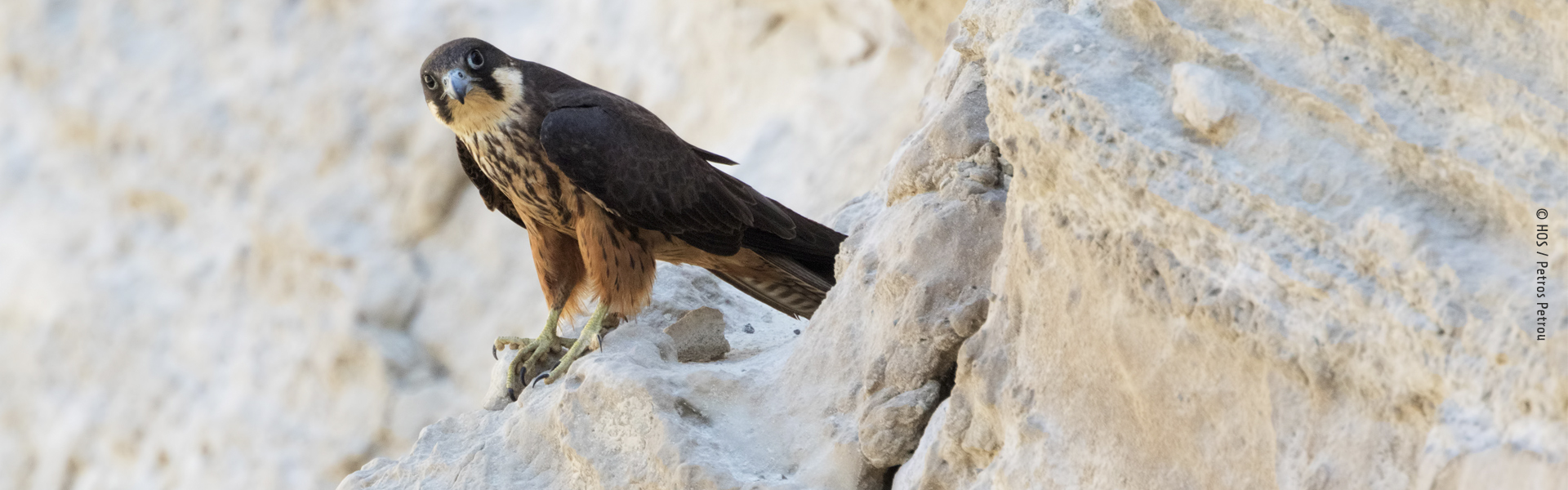
The Eleonora’s Falcon is one of the most emblematic species of Greek wildlife, as Greece hosts the largest percentage of its global population during the breeding season. This migratory falcon is inextricably linked to the Greek islands and the summer period in the country, since the steep island coasts and rocky islets of the Aegean provide ideal conditions for raising its chicks.
Despite being a symbol of the marine environment, the Eleonora’s Falcon is also frequently observed inland. During the pre-breeding period -that is, the time between its arrival in Greece in late April and the start of breeding in August- it moves across various habitats in mainland Greece and the larger islands. These include coastal zones, wetlands, agricultural landscapes, and even mountainous forests. In these areas, it takes advantage of the seasonal abundance of insects to prepare for the energetically demanding breeding season.
By using telemetry, the Hellenic Ornithological Society aims to study the movements of the Eleonora’s Falcon during the pre-breeding period -a relatively unknown phase of the species’ life cycle. The goal is to identify whether there are specific areas that are important for the species during this time and to determine if it faces particular threats in those regions.

Currently, seven (7) Eleonora’s Falcons are equipped with satellite transmitters, providing near real-time data on their exact locations. Most of the transmitters have been placed on Antikythera as part of the activities of the Antikythera Bird Observatory, which in recent years has become a central hub for the study of Eleonora’s Falcon through telemetry. This effort is supported by the Natural Environment and Climate Change Agency (NECCA). Two additional transmitters were placed last year on the island of Skyros as part of the Project “Safeguarding Eleonora’s Falcons in Greece”, implemented with the support of WWF Greece under the “Greek Wildlife Alliance” initiative. More transmitters are scheduled to be placed this year to ensure a representative sample from various regions across the country.
Eleonora’s Falcons that breed on Antikythera and Skyros often travel tens of kilometers away from their nesting colonies in search of food. These foraging areas ultimately play a crucial role in both their reproductive success and overall survival. One notable example is the mountainous regions of central Euboea island (Dirfis, Xerovouni and Kotylaia), which each summer host numerous Eleonora’s Falcons that feed within their fir forests.
We can easily imagine how the very large Eleonora’s Falcon colonies of Skyros and the Northern Sporades would be directly affected by any degradation of these mountainous areas, such as the development of wind energy projects. In fact, more than 120 wind turbines are currently planned for installation in these regions. Similarly, the inland areas of Kythira -regular foraging grounds for Eleonora’s Falcons from nearby islands- are now under serious threat of degradation due to the poorly planned siting of wind farms.